

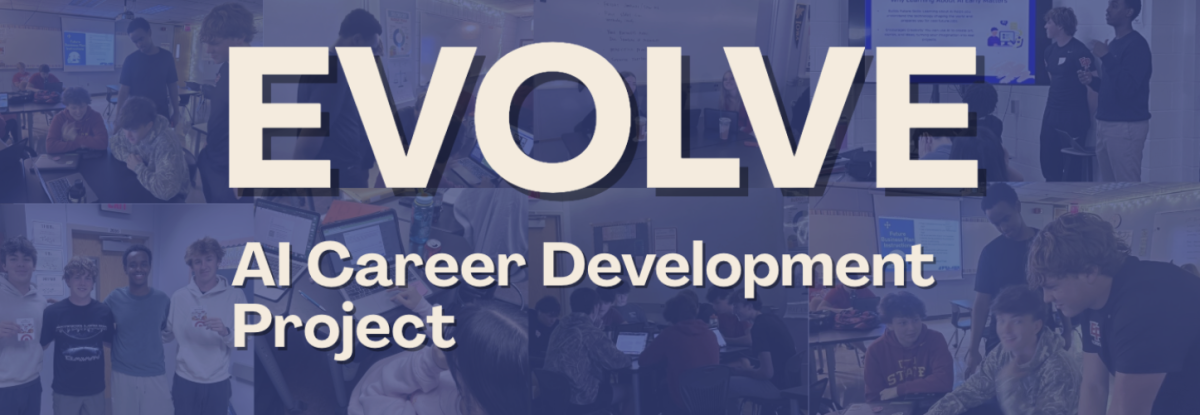
As artificial intelligence expands throughout the working world, many young people looking forward to their careers worry about the stability of their careers, which may be negatively influenced by the effects of AI. Worry about a supposed “AI takeover” has fueled anxiety in young minds concerned about their future careers. In order to combat this uneasiness, Eden Prairie High School seniors Salman Mohamed and Jack Dennsion started Evolve: a project designed to diminish the stigma of the job force revolving around AI while teaching students how to access it ethically and effectively.
Starting off as a DECA project similar to that of Avni Maheshwari and Aishah Alam’s “The LeadHer Project,” ‘Evolve’ aims to empower young elementary, middle, and high school students to use AI beneficially.
“We realized that in our business classes at EPHS have no genuine knowledge of AI,” co-founder Salman Mohamed explained. “So we designed ‘Evolve’ to teach kids better awareness of AI and how to use it professionally.” Mohamed and his co-founder, Jack Dennison, have come up with the idea for Evolve after noticing a lack of AI understanding in both themselves and their peers. Both being heavily involved in business programs at the high school, like DECA and Business Capstones, the two found that having a better understanding of AI would be highly beneficial to them and their peers alike.
Evolve is another project in the DECA Project Management group, specifically under the “Career Development” event. DECA, a competitive extracurricular program for high school students interested in business, involves a Career Development event in which participants organize a project to benefit youth in their community who are looking into future careers. At EPHS, DECA is a large organization led by 6 officers, with one president and five others specializing in marketing, community service, membership, and competition. Mohamed, being this year’s DECA Officer of Community Service, is highly involved in the organization, which is part of what sparked his interest in competing in a Project Management event.
“I take care of pretty much all community-related events that DECA hosts,” Mohamed explained the basis of his leadership position. “There’s always something that I’m doing,” he joked.
On why the two decided to choose a project about AI specifically, Dennison said, “I have always been interested in AI and how it affects students’ abilities to pursue careers. We both had an interest in it, and since we were planning on doing a Project Management event, we thought that Career Development fit our idea the best.”
After conducting preliminary research on the topic, the two found that companies in the modern industry look for employees who have knowledge on using AI in a way that can expedite or assist them in their work efforts. While many worry about AI “taking over” these industries, Mohamed and Dennison’s research found that it is rather a tool that workers can use to help them complete their tasks. In order to help diminish the anxiety that young people in the community experience about AI, the two started the early planning stages after the DECA competition season ended last spring. To start planning the project, the two met with Eden Prairie Online’s coordinator, Dr. Nicholas Kremer, to discuss his involvement in the AI industry.
As well as leading EP Online, Kremer also teaches one of the program’s newer classes: Applying AI in learning and teaching.
“He gave us a lot of insight on how AI will affect future careers,” Dennison shared. “Basically, he told kids to chill out.” While many worry about the implications that AI has on career industries of the future, Kremer shared that there is nothing to worry about as long as students can learn how to utilize the tool properly.
That emphasis on ethics came directly from their conversations with Dr. Kremer, who encouraged them to incorporate both practical applications and guardrails. He explained to them that misusing AI–whether intentionally or not–is far more common when students never learn the boundaries. So inspired, the pair have made sure every Evolve workshop covers examples of proper citation, guidelines on academic integrity, and discussions on data privacy.
Mohamed said younger students, especially, are eager to try things out without knowing how much information they may be giving up. Sharing an anecdote from their sessions with middle schoolers, he said, “Some kids just type in whatever personal stuff they want. They don’t know what that means.” Evolve’s curriculum helps break down those concerns in ways that make sense to younger and older students alike, focusing on what information should stay private and how AI systems store and use data.
One of Mohamed and Dennison’s first events was a career panel they hosted at the EPHS College and Career Expo, where they talked about their work and shared insight on the future of AI with students interested in business. Hope Adesida, a member of the high school’s senior internship program, found that “they explained to me how AI can be seen as helpful instead of an enemy. They gave me a lot of advice on how to use it properly, and it’s helped me recently.”
Being a student in the senior internship program, Adesida often finds herself in situations where she has to get things done quickly and efficiently. Thinking back on how Evolve has helped her in her academic life, she recalled a time when she found herself facing writer’s block and decided to ask AI for help. “In one of my English classes, I was writing an essay and found myself at a roadblock, and so instead of just sitting there, I decided to ask AI for ideas on what to write. Instead of getting it to write the whole thing for me, I asked it for advice on how to start it, and it was very helpful in working on the project,” she shared.
Expanding the program beyond EPHS was the natural next step. In interviews, both founders spoke highly of how some of the most enthusiastic learners they worked with were elementary and middle school students. “They’re really curious,” Dennison said. “They want to know how everything works. We didn’t have to force them to ask questions.” The younger students often asked questions regarding how AI recognizes images, why it sometimes makes mistakes, and whether robots can actually “think”–questions that, according to Mohamed, made them reconsider how to explain the concepts clearly. “They’ll ask stuff that makes us step back and rethink the way we’re teaching it,” he said. “It honestly helps us learn more, too.”
As the project grew, so did the scope of their ambitions. The pair plans to design a website that will act as a resource hub for both students and teachers. The site will include examples from their workshops, how-to guides, and a breakdown of ethical practices. Dennison noted the website is especially important because “not every teacher is confident with AI yet,” and they want to make sure educators have somewhere to turn if they want to incorporate AI literacy into their lessons. As a part of one of their workshops, they showed Lee Moen, a business teacher at EPHS, how to use AI to assist him in making his slideshows more aesthetically pleasing. Moen noted that without the help of Mohamed and Dennison, he wouldn’t have ever thought to learn about how AI can be used as a creative tool in the classroom.
Long-term sustainability has been on their minds, too. As seniors, both founders know their time leading the project is limited. In interviews, they shared plans to recruit underclassmen interested in taking over Evolve after they graduate, especially students involved in DECA or business capstones. They hope that Evolve becomes a staple DECA project at EPHS—evolving each year as AI continues to develop.
One of the surprising things they learned in interviewing students was that many felt embarrassed admitting they didn’t understand AI. “People think everyone else gets it,” Mohamed said, “but honestly, most kids don’t. Even a lot of adults don’t.” That realization shaped the tone of their workshops, which they try to keep relaxed, conversational, and free of judgment. Students who may be hesitant at first often end up asking the most questions by the end.
The two also spoke about the link between AI anxiety and career pressure. A lot of high schoolers already feel overwhelmed by expectations to choose the “right” career path, and the constant warnings about automation can make that stress even worse. Mohamed described AI as one of the biggest generational pressure points. “Kids are hearing about it nonstop,” he said. “It gets in their heads. We’re trying to give them a different way of looking at it.”
Dennison agreed, adding, “We’re not here to tell you AI is perfect. It’s not. But it’s something you’re going to work with, so you might as well understand it.”
This message resonated particularly well with students in business, marketing, and STEM fields, where the integration of AI in expectations for new workers is already beginning to take hold. Mohamed mentioned, “A lot of companies are literally asking if you know how to use AI tools” in their applications. Firsthand knowledge of workplace trends became a major driver for the project.
With competition season fast approaching, Mohamed and Dennison are busily readying their written reports, presentation boards, and documentation. But despite the competitive nature of DECA, both were quick to underscore how, above all, Evolve is driven by community impact. They want their peers—and younger students—to walk away feeling confident in their ability to navigate a world re-shaped by AI developments. “We just want to help people understand what they’re working with,” Mohamed said to wrap the interview. “Once you understand it, it’s not as scary.” Dennison agreed. “If we can get people to feel less intimidated and more prepared, that’s the whole point. AI isn’t going anywhere, so education shouldn’t stop either.” With Evolve, the two aim to bridge a gap between curiosity and understanding, fear and confidence. As their project continues to expand, one thing becomes clear: the future may be unsure, but students don’t have to face it unequipped.